PLEA 2020 conference proceedings are now available

The PLEA 2020 conference proceedings have been uploaded to the official repository of the University of A Coruña.

Title: Planning Post Carbon Cities: 35th PLEA Conference on Passive and Low Energy Architecture, A Coruña, 1st-3rd September 2020: Proceedings

Author(s): Rodríguez-Álvarez, Jorge
Gonçalves, Joana Carla

ISBN: 978-84-9749-794-7

You can download the proceedings here: https://ruc.udc.es/dspace/handle/2183/26695

Alternatively, you may access the PLEA proceedings page of this website to download the files (login is required).

Posted in Uncategorized | Leave a comment

PLEA 2020 – First virtual PLEA Conference

PLEA 2020 – the first virtual PLEA Conference has just finished!

Thank all the participants for joining the conference online and contributing your high-quality work!

Sincere thanks to the PLEA 2020 organising team led by Dr. Jorge Rodríguez Álvarez for all the excellent work and efforts to make the first virtual PLEA conference a great success!


(Photo from PLEA 2020 A Coruña Twitter)
Posted in Uncategorized | Leave a comment

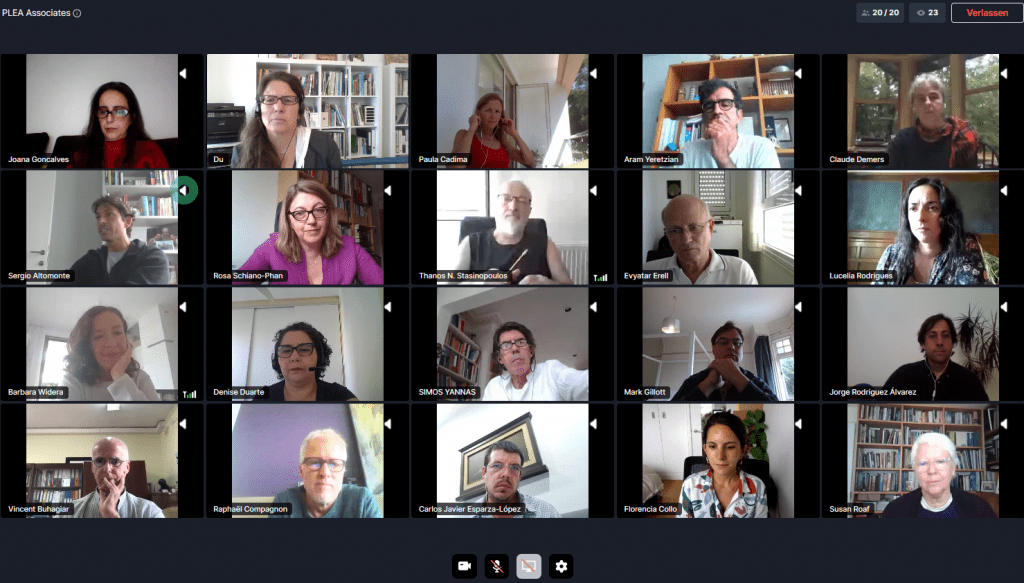
PLEA Associate Meeting at PLEA 2020

PLEA Associates met online at PLEA 2020. Thank you for all your participation and contribution!

Posted in Uncategorized | Leave a comment

Household Waste as a Low-Tech Cool Roof Solution. A Vernacular Approach for Climate Change Mitigation and Adaptation Strategy

A gradual increase in earth’s temperature is becoming a reality faced nowadays. Communities in informal settlements or deprived neighbourhoods living in buildings of poor quality are the most vulnerable to indoor heat stresses. Six test cubes were constructed on the rooftop of a residential building in Cairo, Egypt. Ten different thermal roof insulation ideas were tested and experimented in an urban living lab setting under real climate conditions. The 10 solutions were tested during peak summer hours and their efficiency was monitored along two consequent time intervals, where 5 solutions were monitored at a time. The two best solutions were tested again in winter. This experimental study showed that using reed mats and reed crate with wet burlap can reduce temperatures up to 3.5 degrees compared to conventional roof construction methods. The feasibility of the proposed solutions, their cost efficiency and their maintenance were discussed. We hope this experimental study can be scaled up to help vulnerable groups in informal or deprived areas to reduce their level of suffering from indoor heat stress. Low-tech and low-cost roof insulation can offer adequate thermal comfort for marginalized populations.

Posted in Conference Poster | Leave a comment

Indoor Farming in Future Living Models

According to a UN report, by 2050, the world’s population will reach around 9.7 billion. This growth, alongside a changing climate, will strain natural resources, especially the food supply chain. There will also be issues in relation to human health, education and well-being, due to people’s growing distance from food supply. Previous projects have sought a solution to these problems through vertical farming. Producing food within an urban environment suggests a different worldview for the next generation of living and a new urban lifestyle. In collaboration with SOM, this project explores the feasibility of using a network of hybrid farms to address London’s growth challenges. The research included solar studies of 3 building geometries in the identified farming zones within the building. The thermal analysis, conducted in studied areas, revealed that the optimum footprint is a square geometry. As an example, the lettuce was chosen to quantify and compare the production potential, food miles, energy and water consumption between the main farming systems. The building’s design maximises daylight and sunlight access in order to produce vegetables using the least amount of artificial energy. In this manner, the hybrid farms minimise energy demand, water consumption, transportation distances and land use.

Posted in Conference Poster | Leave a comment

Analysis of urban scale factors for data center waste-heat use: Three case studies in Sweden

Data centers (DCs) bring important positive economic impacts to the cities and regions where they are established, however, in exchange of a high electricity consumption, which in the end is transformed into unused waste-heat. Only 10% of the DCs in Sweden utilize their waste-heat by generally plugging it into the district heating (DH) network. Despite having a DH tradition in most of Swedish cities, DC waste-heat utilization is not a rule. Data center strategical planning and urban strategical planning should be well coordinated, in order to offer alternative strategies to integrate the DCs waste-heat inside the local sectors/ services constellation in need of heat. Therefore this paper will focus on understanding how the urban planning practice can support DC’s waste heat utilization by proposing an urban scale analytical approach to identify factors in relation to spatial and energy resource planning at a municipal level that may facilitate the DCs’ waste heat utilization in cities.

Posted in Conference Poster | Leave a comment

Life Cycle Cost and Carbon Appraisal for a Prefabricated Residential Development in London

This paper provides an overview of the opportunities for renewable energy generation and low-carbon solutions in a prefabricated residential development (which includes some commercial space) in London. Its objective is to identify the optimum design of mechanical and electrical (M&E) plant and energy solution configurations. As well as technical appraisals and assessments of compliance with planning policies, a broad comparison of the capital cost and life cycle cost (LCC) of different options is carried out. To assess the costs, specifically the energy costs, and the carbon implications of various design scenarios, this study has reviewed the capital costs as well as the operational costs (cost in use) of applying various renewable and low carbon energy technologies to different primary heating strategies, over a 30-year life cycle. This is the same period included within the operational model. Accordingly, scenarios involving the use of electricity, gas and air source heat pumps (ASHPs) were examined and compared. The results suggest that ASHPs have the lowest energy and carbon emissions but high LCC, while the gas plant option has the lowest capital and maintenance costs.

Posted in Conference Paper | Leave a comment

Critical Analysis on Research Trend on Passive and Low Energy Architecture Study Through Text Data Mining Technique in the Period of 2006 to 2018

As one of the leading conferences in the study area of passive and low energy architecture, the Passive and Low Energy Architecture (PLEA) Conference has presented continuously great efforts and innovative ideas from worldwide research communities and professional society in promoting the study of passive and low energy architecture. With the rapid urbanization and technological progress in the past decade, more and more research branches of PLEA emerged. Clarifying the research trend variation would benefit the research communities in identifying research gaps in this research area. This paper examines the PLEA proceedings from 2006 to 2018 with text data mining techniques in Python environment. More than three thousand lines of research paper titles have been analyzed to find out the research trend variations. The analysis reveals that main concerns of PLEA research have remained stable during the past decades. The main concerns are, indoor and outdoor thermal comfort in building level, and urban heat island effect in regional level. Natural ventilation is one of the most discussed technique in passive design strategies. Enlightening but rare mentioned keywords are ‘visual comfort’, ‘life cycle’, ‘integrated design’, ‘urban morphology’, ‘urban micro-climate’, ‘climate change’, ‘parametric study’, ‘benefit reusing’, ‘neural network’. In 2018, more advanced computation methods have been involved in PLEA research. The social house, school, dwelling, office, and residential buildings are the building types that being focused most. Research gaps lie in rural buildings that are occupied by about half of the global population and the study on accessible daylight via reasonable architectural design. This study may serve as an informative reference for research communities, industry practitioners and non-profit organizations to appreciate passive and low energy architecture research trends and developments.

Posted in Conference Paper | Leave a comment

The Environmental Performance Of Temporary Urban Interventions: Technical Assessment Of Regeneration Initiatives In The City Centre Of São Paulo, With Focus On Thermal And Acoustic Performance

Temporary urbanism is an approach to reactivate urban spaces through short-term interventions in a range of urban contexts. In central São Paulo, the Luz and Santa Ifigênia neighbourhoods, characterized by deprivation of their physical environments and social structures, were the focus of this investigation. The Mungunzá Container Theatre and the General Osório Square, located within these neighbourhoods, were selected as case studies. Whilst the thermal performance of the container theatre itself was the main interest, in the case of the Square the fundamental issue was the environmental noise. The objective was to identify adequate strategies to improve environmental conditions in these locations in order to enhance positive social impact, and, then, contribute to the regeneration of these neighbourhoods. This research was based on fieldwork and analytical procedures of thermal and acoustic performances. In the container theatre building, the adoption of external shading and wider openings for ventilation reduced its indoor peak temperatures and delivered thermal comfort during the warmest period of the year. In the Square, sound absorber road surface material and an acoustic shell were proposed to reduce noise and promote better acoustic quality for outdoor performances.

Posted in Conference Paper | Leave a comment

The Effect of Increasing Vegetation Cover on Energy Demand for Heating and Cooling Buildings in a Dense Mediterranean City

The study examines the effects of adding vegetation to a Tel Aviv neighbourhood on the microclimate, and subsequently on electricity consumption for heating and cooling. Computer simulation was employed to generate modified weather files that account for urban effects in different building configurations. These files were then used as inputs for detailed computer simulation of building energy performance. Elevated night-time temperatures in the urban location increase summer cooling relative to the reference rural site, but reduce winter heating, resulting in a net decrease of 2-7% in overall electricity use for heating and cooling (depending on building characteristics). The reduction in the potential for cooling by night ventilation will increase the prevalence of air conditioning use and make buildings more vulnerable to potential loss of electric power during episodes of extreme heat. Implementing a strategy of extensive planting, so that a green surface fraction of 0.5 is obtained, results in a mean annual temperature reduction of about 0.3 °C and an energy saving relative to the current condition of about 2-3%.

Posted in Conference Paper | Leave a comment